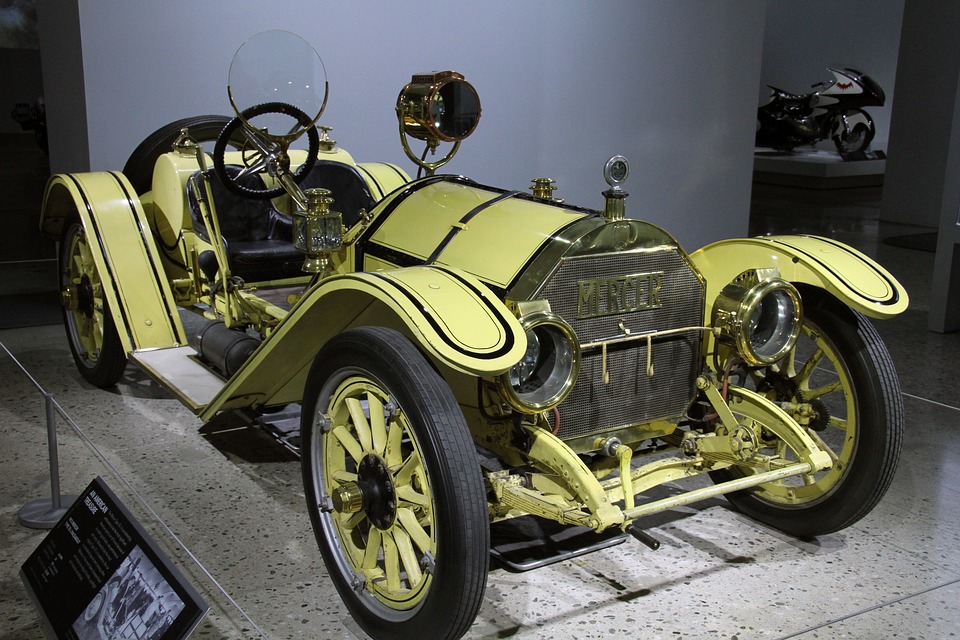
The Petersen Automotive Museum is located on Wilshire Boulevard along Museum Street in the Miracle Mile neighborhood of Los Angeles. The Petersen Automotive Museum, one of the world’s largest automotive museums, is a non-profit organization specializing in automotive history and related educational programs.
History
Founded June 11, 1994, by magazine publisher Robert E. Petersen and his wife, Margie, the $40 million Petersen Automotive Museum is owned and operated by the Petersen Automotive Museum Foundation. The museum was originally housed in the Los Angeles County Museum of Natural History before being moved to the historic department store designed by Welton Beckett. Opened in 1962, the building first served as a short-lived branch of Seibu Department Stores in the United States and then operated as a department store in Orbach from 1965 to 1986. Six years after Orbach closed, Robert Petersen chose the virtually windowless location as the perfect place for a museum – allowing exhibits to be displayed without the damaging effects of direct sunlight.
In 2015, the museum underwent an extensive $125 million renovation. The building’s façade was redesigned by architectural firm Kohn Pedersen Fox and is an assembly of 100 tons of 304 Type 14 steel in 308 sections, 25 supports and 140,000 custom stainless steel screws. The designers of The Scenic Route created the interior space to accommodate the changing exhibits. The renovated museum opened to the public on December 7, 2015.
Exhibition

Vehicles, now considered “alternative energy,” have been around since the creation of the automobile. In 1900, you could see steam, electric, and gasoline-powered vehicles on the roads of major American cities. In New York, Boston, and Chicago, for example, 34% of cars were electric, and nearly half were steam-powered.
After the discovery of significant oil reserves in Texas and California, the price of gasoline dropped significantly in the 1920s. As a result, gasoline-powered internal combustion engines became incredibly popular, although many engineers believed that alternative energy sources still held promise.
Experiments continued with alternative fuels, electricity, and even steam throughout the twentieth century. Today’s alternative-power vehicles are designed to use fuel more efficiently than conventional gasoline-powered vehicles, reducing or eliminating emissions. These vehicles contain state-of-the-art, often experimental, technology that could be the basis for future vehicles.
Visitors get behind the wheel and experience a dynamic car racing experience in one of eight specially selected events. Ten racing simulators offer a custom version of Forza Motorsport 7.
Artifacts and information explaining how these exciting elements of automotive culture are created are also on display.
The Forza Motorsport racing tour ends at 5:30 p.m. or 30 minutes before the museum closes.
Automechanical Institute and Automotive Experience
Thanks to a groundbreaking partnership with Disney / Pixar, visitors of all ages can now be part of an amazing experience found only at the Petersen. The Automotive Mechanics Institute, inspired by the animated film, immerses visitors in a variety of interactive stations where they learn about the mechanical systems that make cars work. Visitors can also draw and personalize virtual cars, as well as race and paint their own car characters to take home, and our little car lovers can scale toy cars around the racetrack.
At the Car Mechanics Institute, cars can take part in the CARSpad Experience game for iPad, where visitors create their own virtual race car.
ArtCenter Design Studio
ArtCenter College of Design’s influence on the world of transportation dates back to its founding in 1930. The Pasadena, California-based institution is a leader in art and design education that challenges students with an interdisciplinary curriculum that explores socially responsible, creative and design-based solutions to real-world problems. ArtCenter offers undergraduate and graduate degrees as well as a wide range of open art and design courses for individuals at every stage of their education or professional development. It remains focused on its core educational mission of encouraging students to learn how to create and affect change.
The college’s transportation and industrial design programs offer rigorous courses of study that emphasize technical ability and creative thinking. Students benefit from a network of graduates well-connected in the automotive industry, proximity to more than 20 cutting-edge automotive design studios, and the beauty and temperate climate of the region that has inspired generations of designers before them.
Collections
The museum’s 25 galleries showcase more than 100 cars. The remaining half of the collection is housed in a vault located in the basement of the building. There are age restrictions and entrance fees to view the vault collection. The first floor is devoted to automotive craftsmanship, displaying many extravagant cars. The second floor is mostly concerned with industrial engineering, including design, performance, and a collection of interactive learning exhibits. Special displays on industrial floorplans of floor races, motorcycles, hotrods and customs. The third floor chronicles automotive history with an emphasis on Southern California automotive culture.